
Is your EAM system too rigid to adapt? Discover how the EAM Process Designer drives successful asset management process optimization through visual configuration, automation, and strict compliance control.
In the wave of digital transformation, asset-intensive industries—such as manufacturing, energy, and transportation—face a massive management challenge. Many executives encounter an awkward reality: after spending a fortune implementing an Enterprise Asset Management (EAM) system, frontline employees refuse to use it because the workflows are rigid, complex, and disconnected from reality.
The stakes are high. According to research by McKinsey & Company, nearly 70% of digital transformations fail to meet their goals, often due to employee resistance and rigid systems that cannot adapt to user needs.
The success of an EAM system lies not just in its features, but in its ability to support continuous asset management process optimization. The bridge connecting evolving business needs with system functionality is the EAM Process Designer. This article explores how this core component solves the “implementation gap” and serves as the engine for true optimization.
1. Why is “Asset Management Process Optimization” a Survival Skill?
Before diving into the tools, we must understand the urgency. Traditional asset management models often suffer from three major pain points that stifle growth:
(1) Disconnect Between Workflow and Reality
Business is dynamic. A company might expand from a single factory to multiple global sites, or shift from reactive maintenance to predictive maintenance. However, traditional EAM software often has workflows “hard-coded” into the system. Changing a simple approval node might require vendor intervention and weeks of development. This lag severely hinders asset management process optimization.
(2) The Information Silo Effect
Procurement, warehousing, maintenance, and disposal often operate in isolation. Without a unified process to thread these stages together, data breaks down. For example, a work order is generated, but inventory isn’t reserved, leading to parts shortages during critical repairs.
(3) Compliance Gaps
Many companies have Standard Operating Procedures (SOPs) on paper, but they aren’t enforced digitally. In practice, unauthorized approvals or skipped safety checks occur frequently.
Therefore, genuine asset management process optimization isn’t just about drawing flowcharts; it’s about building a digital system that is agile, automated, and compliant. The EAM Process Designer is the tool that makes this possible.
2. Visual Drag-and-Drop: Lowering the Barrier for Asset Management Process Optimization
For most IT departments and Operations Managers, the biggest barrier to asset management process optimization is the “technical threshold.”
In the past, adjusting a business process required modifying the underlying source code. This was expensive and risky. Modern EAM Process Designers have revolutionized this with No-Code technology.
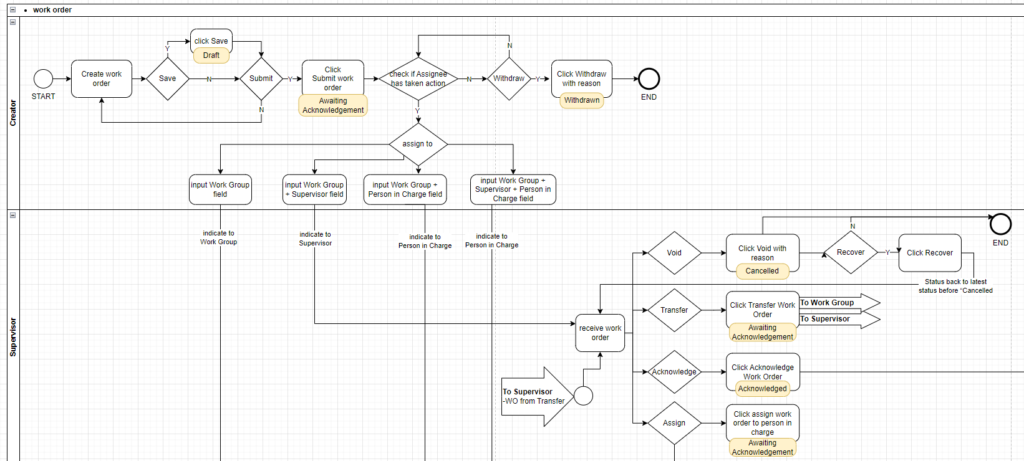
- “What You See Is What You Get” (WYSIWYG): Operations personnel do not need coding skills. They can simply drag and drop nodes—such as “Start,” “Approve,” “CC,” or “Sub-process”—onto a canvas to build workflows that match the company’s actual operations.
- Agile Response to Change: Speed is critical. Industry insights from Forrester Research suggest that low-code platforms—like modern EAM designers—can accelerate development by up to 10 times compared to traditional coding. This agility allows IT teams to implement asset management process optimization strategies in days, not months.
This is where platforms like SAMEX EAM excel. By providing an intuitive, visual workflow engine, SAMEX empowers users to modify complex processes without writing a single line of code, turning the “10x speed” potential into a daily reality.
3. Automation Triggers: Connecting the Dots for Holistic Asset Management Process Optimization
Another core goal of asset management process optimization is to eliminate manual friction and boost efficiency.
In systems without a robust workflow engine, Work Order Management, MRO Inventory, and Asset Registers remain isolated islands. Manually transferring data between them is slow and error-prone. The “Automation Trigger” feature of the EAM Process Designer is the solution.
By setting conditional triggers, the system achieves true end-to-end automation, deepening the impact of asset management process optimization:
- Automated Dispatching: When a frontline worker reports a fault, the system analyzes the asset type (e.g., Electrical vs. Mechanical) and location, automatically dispatching the work order to the correct maintenance team without human intervention.
- Inventory Linkage: Once a technician accepts a job, the system automatically triggers a parts requisition process. Upon approval, inventory is deducted in real-time, and low-stock alerts are sent if necessary.
- Closed-Loop Archiving: When maintenance is marked complete, the system automatically updates the asset’s lifecycle history and triggers an acceptance review. Once approved, the ticket is archived.
This seamless automation breaks down business barriers, ensuring data accuracy and timeliness—a prerequisite for deep asset management process optimization.
4. Handling Complexity: Conditional Logic Makes Asset Management Process Optimization Flexible
Real-world business scenarios are rarely linear. A “one-size-fits-all” approach fails because different assets require different protocols.
For instance, scrapping a low-value tool might only need a manager’s signature, while decommissioning a million-dollar turbine requires approval from the CFO and the EHS department. If the software cannot handle this variance, asset management process optimization becomes impossible.
The EAM Process Designer uses Conditional Branching and Logic Gates to adapt to this complexity:
- Value-Based Routing: The system can be configured with rules: “If Asset Value < $5,000, route to Department Manager; If Asset Value ≥ $5,000, route to VP of Operations.”
- Urgency-Based Routing: For “Emergency” priority work orders, the system can bypass standard administrative approvals and route directly to the repair crew to minimize downtime.
- Cross-Departmental Collaboration: If an internal repair fails, the workflow can automatically trigger an “Outsourcing Request” sub-process, bringing the Procurement team into the loop.
This rule-based dynamic routing ensures that the system is rigid where it needs to be (compliance) and flexible where it needs to be (speed), marking a mature stage of asset management process optimization.
5. Granular Permissions: Ensuring Compliance in Asset Management Process Optimization
Many companies focus on speed during asset management process optimization, overlooking a critical element: Risk Control.
An EAM Process Designer is not just a tool for moving tasks; it is a tool for governance. It utilizes Granular Permission Controls to solidify management rules within the software:
- Node-Level Access Control: It explicitly defines “Who can view, Who can edit, and Who can approve” at every step. For example, a technician can fill in the “Repair Diagnosis” field but cannot modify the “Failure Root Cause” field after submission.
- Mandatory Validation Rules: The system can enforce SOPs digitally. For instance, it can block a workflow from proceeding if a “Spare Parts Request” is not linked to a valid “Work Order,” or if a “Scrap Request” lacks an uploaded “Technical Assessment Report.”
By embedding these rules into the workflow, companies ensure that asset management process optimization does not come at the cost of compliance. It prevents asset leakage and ensures audit readiness.

6. Data-Driven Decisions: The Cycle of Continuous Asset Management Process Optimization
Optimization is a journey, not a destination. But how do you know if your current workflow is actually efficient? The old adage holds true: “You cannot manage what you do not measure.”
A robust EAM Process Designer does more than execute tasks; it acts as a comprehensive audit tool. It automatically logs the timestamp, duration, and operator for every step in the workflow. This granular data allows managers to perform Bottleneck Analysis to identify exactly where efficiency is leaking:
- Identify Process Lags: Is a purchase request sitting in a manager’s inbox for an average of 3 days? The system highlights these delays, allowing you to redesign the approval hierarchy.
- Optimize Resource Allocation: Data might reveal that specific maintenance teams are overloaded while others are idle, enabling dynamic resource balancing.
The financial impact of this visibility is profound. According to McKinsey & Company, leveraging such data-enabled optimization can reduce overall maintenance costs by 10–40% and extend asset life by 20–40%.
By transforming raw process data into actionable insights, companies can move from “reactive fixing” to “predictive planning.” This creates a virtuous cycle where every workflow adjustment is backed by evidence, ensuring that asset management process optimization delivers a tangible, long-term return on investment.
The EAM Process Designer is the Heart of Optimization
To summarize, companies struggling with EAM adoption must look beyond standard features and evaluate the adaptability of the system.
Asset management process optimization is not just about changing a policy; it is about upgrading your digital infrastructure. A robust EAM Process Designer transforms rigid software into a living, breathing system through visual configuration, automated workflows, strict compliance, and data analytics.
If your organization is seeking the best practices for asset management process optimization, prioritize the capabilities of the workflow engine. It is the core differentiator that determines whether your digital transformation will stagnate or thrive. Embrace the Process Designer, and you embrace a more efficient, compliant, and intelligent future for your assets.