Introduction
As industrial infrastructure ages and supply chain delays persist, the financial toll of reactive maintenance has reached unprecedented levels. In fact, unplanned equipment downtime alone costs the average Fortune 500 company an astonishing $2.8 billion every year, representing roughly 11% of total revenue. For facility managers and operations executives, relying on a “run-to-failure” approach is no longer a viable option. The solution lies in rigorous preventive maintenance scheduling, a proactive strategy designed to service equipment before catastrophic failures occur.
Implementing effective preventive maintenance scheduling is the cornerstone of modern Enterprise Asset Management (EAM). When executed correctly, it transitions a facility from chaotic firefighting to structured, predictable operations. This comprehensive guide explores the true cost of downtime in 2026, the staggering return on investment (ROI) of proactive maintenance, and how advanced CMMS solutions are automating these critical workflows.
The Staggering Cost of Unplanned Downtime in 2026
The manufacturing and facility management landscapes are facing a perfect storm. The average age of industrial fixed assets has reached 24 years—the oldest average age in nearly seven decades. Coupled with a growing shortage of skilled labor, this aging infrastructure is driving up the mean time to repair (MTTR) from 49 minutes to an average of 81 minutes.
When equipment fails unexpectedly, the costs extend far beyond the immediate repair. Facilities must contend with halted production lines, delayed shipments, idle labor, and expedited shipping fees for emergency replacement parts. According to recent industry data, 55% of maintenance professionals cite paying more for parts as the primary reason for higher downtime costs .
To combat these escalating expenses, organizations must prioritize preventive maintenance scheduling. By systematically inspecting, cleaning, and replacing components at predetermined intervals, facilities can drastically reduce the frequency and severity of unexpected breakdowns.
The 545% ROI of Preventive Maintenance Scheduling
One of the most compelling arguments for adopting a proactive maintenance strategy is the sheer economic value it generates. While establishing a preventive maintenance program requires an initial investment in labor, training, and software, the long-term savings are exponential.
A landmark study analyzing the economic impact of maintenance strategies revealed that preventive maintenance delivers an average Return on Investment (ROI) of 545% . This phenomenal return is achieved through several key mechanisms: Extended Asset Lifespan through regular servicing prevents premature wear and tear, allowing organizations to defer costly capital expenditures on new equipment. Reduced Energy Consumption means well-maintained machinery operates more efficiently, with energy savings alone accounting for approximately 7% of the total ROI . Minimized Production Losses are achieved by scheduling maintenance during planned operational pauses, avoiding the devastating financial impact of halted production during peak hours.
To fully realize these benefits, maintenance teams must move beyond manual spreadsheets and whiteboards. Modern preventive maintenance scheduling requires the robust data management capabilities of a Computerized Maintenance Management System (CMMS) or an EAM platform.
Overcoming the “Ambition vs. Execution” Gap
Despite the clear financial advantages, many organizations struggle to fully implement proactive strategies. A recent survey highlighted a significant gap between ambition and execution: while 90% of facility managers believe in the value of preventive maintenance, only 26% are actually practicing it as their primary strategy . Furthermore, 58% of facilities still spend less than half their time on scheduled maintenance tasks.
Why does this gap exist? Often, it stems from a lack of adequate scheduling tools and an over-reliance on outdated, manual processes. When technicians are bogged down by paperwork and disorganized data, they inevitably default to reacting to the loudest alarm.
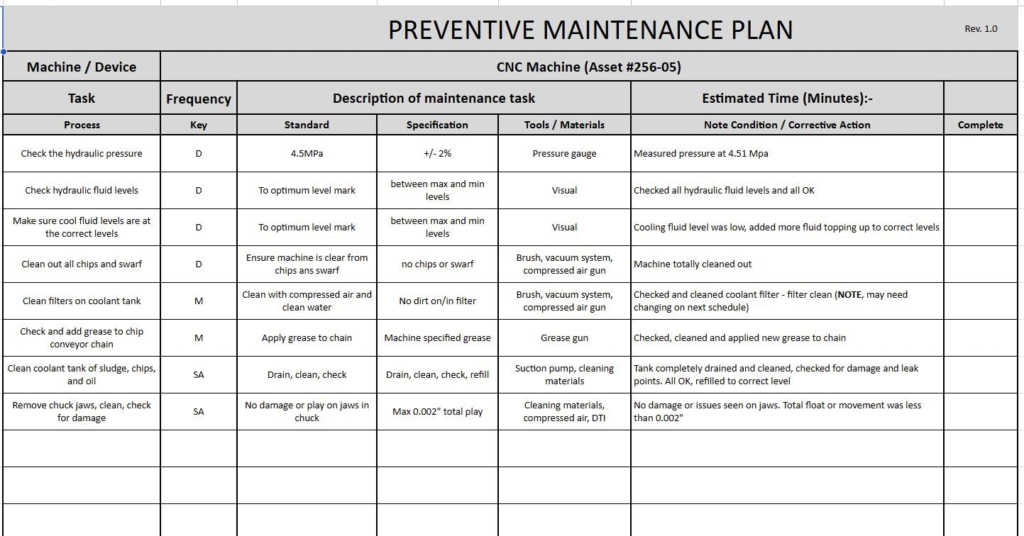
Bridging this gap requires a fundamental shift in how work orders are managed. By leveraging EAM software to automate preventive maintenance scheduling, organizations can ensure that critical inspections are never missed. These systems automatically generate work orders based on calendar dates, meter readings, or specific usage thresholds, instantly assigning them to the appropriate technicians with detailed checklists and safety protocols.
Reactive vs. Preventive Maintenance Comparison
| Metric | Reactive Maintenance (Run-to-Failure) | Preventive Maintenance Scheduling |
| Primary Focus | Fixing broken equipment | Preventing failures before they occur |
| Downtime | High, unpredictable, and costly | Low, planned, and controlled |
| Labor Costs | High (overtime, emergency call-outs) | Optimized (scheduled during regular hours) |
| Asset Lifespan | Shortened due to excessive wear | Maximized through regular servicing |
| Overall ROI | Negative | Up to 545% |
Integrating IoT and Predictive Analytics in 2026
While preventive maintenance scheduling is highly effective, the industry is rapidly evolving toward even more advanced methodologies. In 2026, the integration of Industrial Internet of Things (IIoT) sensors and Artificial Intelligence (AI) is transforming how maintenance is planned.
Currently, 35% of maintenance professionals report using sensors and IIoT devices extensively to monitor equipment health in real-time. By continuously tracking metrics such as vibration, temperature, and fluid levels, these sensors provide the data necessary for predictive maintenance.
When predictive analytics are combined with automated preventive maintenance scheduling, the results are transformative. Instead of servicing a motor every 90 days regardless of its condition, the EAM system can trigger a work order exactly when the vibration data indicates an impending fault. This hybrid approach ensures that maintenance is performed precisely when needed, eliminating unnecessary labor and parts consumption. For organizations looking to enhance their operations, exploring comprehensive solutions like SAMEX Enterprise Asset Management can provide the necessary framework for integrating these advanced technologies.
How to Optimize Your Preventive Maintenance Scheduling
To maximize the impact of your maintenance program in 2026, consider the following actionable strategies:
- Prioritize Critical Assets: Not all equipment requires the same level of attention. Conduct a criticality analysis to identify the assets that have the highest impact on production and safety. Focus your preventive maintenance scheduling efforts on these high-priority machines first.
- Leverage High-Quality Data: The success of any scheduling software depends on the accuracy of the data fed into it. Ensure that your CMMS is populated with clean, standardized information. As highlighted in a recent industry guide on 7 Shocking Ways High-Quality CMMS Data Unlocks Your EAM’s True Potential, data quality is crucial for long-term success.
- Standardize Work Orders: Create detailed, step-by-step checklists for every preventive maintenance task. This ensures consistency, improves safety, and aids in knowledge capture as older technicians retire.
- Monitor and Adjust: Continuously review your maintenance metrics, such as planned vs. unplanned work ratios, and adjust your schedules based on actual asset performance and historical data.
Conclusion
In an era defined by aging infrastructure and rising operational costs, relying on reactive repairs is a recipe for financial strain. By fully embracing preventive maintenance scheduling, facility managers can take control of their operations, drastically reduce unplanned downtime, and achieve an exceptional ROI.
The transition from reactive to proactive maintenance requires a commitment to better processes and the adoption of modern EAM technologies. By automating schedules, standardizing workflows, and eventually integrating predictive IoT data, organizations can ensure their assets operate at peak efficiency well into the future. For more insights on optimizing your maintenance strategy, explore how Predictive Maintenance in Facility Management can further cut costs and maximize uptime.